




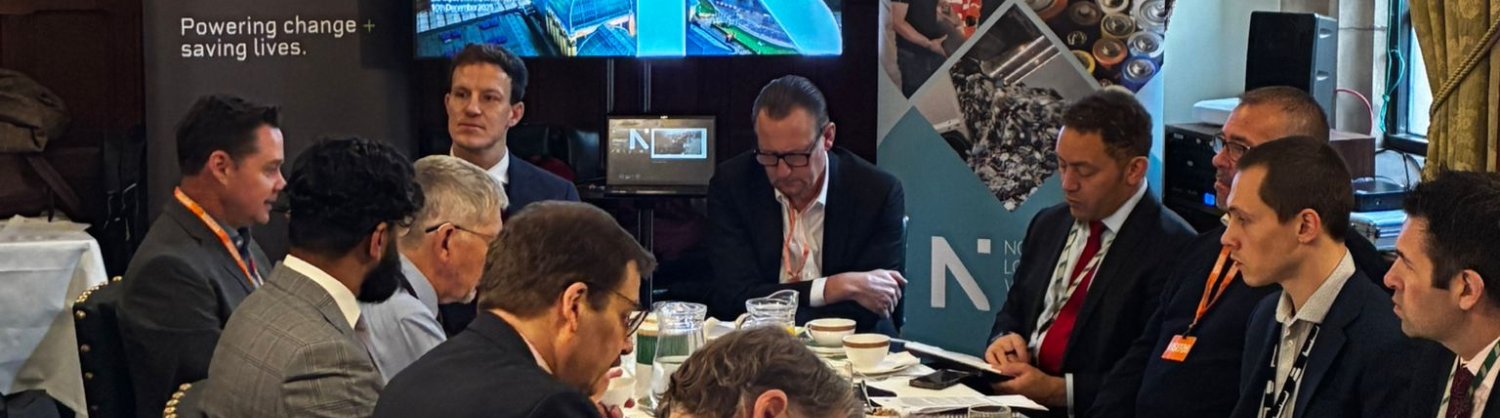
A cross-sector coalition of key stakeholders met at the House of Commons last week to discuss the skyrocketing increase of fires caused by lithium-ion batteries. Attendees included parliamentarians and local government councillors alongside representatives from waste management companies, the third sector, retail and the London Fire Brigade.
Sponsored by Alistair Strathern MP and co-hosted by NLWA and Electrical Safety First (ESF), the robust round-table discussion brought together key stakeholders to share insights and potential policy interventions to tackle the increasing problem of waste battery fires. Lithium-ion batteries have become ever-present in everyday life – found in phones, vapes and other household tech – and have become a major waste problem. Easily damaged in the back of bin lorries and at waste facilities, when incorrectly thrown away these batteries can instantly spark fires and reach temperatures of up to 800 degrees.
Lawmakers in attendance included north London MP Calvin Bailey, representative for Leyton and Wanstead, Lord Foster of Bath, and MP for Telford Shaun Davies. Meeting sponsor Alistair Strathern, MP for Hitchin, has taken a strong personal interest in the issue after seeing the damage caused by battery fires at waste facilities in his constituency. In his opening remarks Mr Strathern highlighted his concerns, noting the wide-ranging impacts of these fires not just at the waste facilities but on local communities exposed to toxic fumes and potential water pollutants.
“After repeated fires in Hitchin, it’s clear this is not a distant problem: it’s here on our doorstep," said Mr Strathern. "These fires damage infrastructure, and release toxic pollutants. We need action to ensure lithium batteries are recycled safely, always. This is about protecting communities and the environment while supporting innovation in green transport and technology. This conversation was the start of a wider push for practical, evidence-based solutions.”
Other remarks came from ESF Technical Director Luke Osborne and NLWA Chair Councillor Clyde Loakes, who shared more technical insights on the waste management of lithium-ion batteries. This was followed by an open discussion in which attendees shared valuable insights from their unique perspectives on the problem. Topics of discussion included the viability of kerbside electricals collections, the merits of a deposit return scheme for some electrical items, consumer awareness of electricals recycling, and the enormous waste stream created by vapes. Participants were in general agreement that central government funding and support was crucial in achieving any significant reduction in battery fires.
“Fast electricals sold through online marketplaces are flooding the UK with unsafe lithium-ion batteries,” said Luke Osborne. “The Battery Breakdown campaign shows why stronger regulation through the Product Regulation and Metrology Act must make batteries like this safer alongside other electrical goods. Government must promote responsible disposal not only through public awareness, but by placing enhanced responsibilities on producers.”
Councillor Clyde Loakes echoed this call for government action, while also thanking the participants for their contributions and for making the event a success. “The enormous risk of battery fires can only be curbed with the support of lawmakers and policy intervention. That’s why it was so important for us to gather together experts from across industry to understand what that policy intervention might look like.
“We look forward to partnering with these organisations again in the future to make sure we keep the important issue of waste battery fires high on the government agenda.”